The Bunessan Mill is open to the public all day, every day of the year. This 19th-century watermill and drying kiln closed in 1914 when the miller went off to fight in the war, and later deteriorated into a roofless ruin. Now the Ross of Mull Historical Centre (RoMHC), based in the original miller’s cottage next door, has made the remaining structure safe and welcoming for visitors to explore its history.
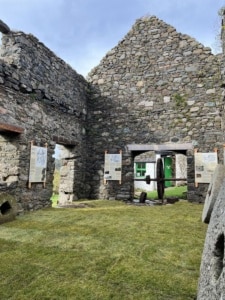 Three huge millstones, each weighing around a ton, are on display in the mill alongside some of the original machinery. Imaginative, informative interpretation boards describe the mill’s history and show how it might have looked and worked in its heyday, including how its machinery might have been arranged. These additions are part of a major renovation project undertaken by the RoMHC Trustees to preserve what remains of the mill for the future.
The mill would have been the focus of the community from 1744, with every farmer and crofter bringing grain there to be dried and ground. How did it all work? Water from the river higher up the valley travelled through a lade, a man-made ditch, with a series of sluice gates controlling its flow. At the end of the lade, a wooden trough called a launder carried the water to the top of the massive 14ft-diameter waterwheel, where it had the greatest effect in turning the wheel. Shafts and cogs connected the wheel to the millstones on the first floor. The stones worked in pairs: the top stone turned over the bottom one, grinding the grain fed between them. Keeping this impressive operation running required a miller skilled in carpentry, engineering and stonemasonry, as well as an astute understanding of the river’s flow and how to control it. All these skills were needed daily.
Next door, Millbrae Cottage offers another way to discover how the people of the Ross of Mull lived and worked in the past. RoMHC bought the mill site and adjacent cottage in 2001 and turned the cottage into a Heritage Centre. Small, but packed with artefacts and storyboards, the centre has a local volunteer on hand to answer questions and share more about the displays. You can browse books on the area’s history and walking guides for sale, with tea and coffee also on offer. The Heritage Centre also houses an extensive archive of local reference material, including census, parish and emigration records, available for genealogy research. It is open from Easter to October, Monday to Friday, 10am–4pm. Entry is free, but donations are welcome. The Community Garden in the grounds is accessible at any time.
The Heritage Centre, the mill and the community garden are in a delightful setting, accessed via a short footpath and bridge over the River Bunessan on the shores of Loch na Làthaich. Car parking is available on the roadside across from the gate to the Centre.
For further information and to buy publications online, visit the Ross of Mull Historical Centre’s website
The mill’s new lease of life was made possible by grants from The National Lottery Heritage Fund, Historic Environment Scotland and The Pilgrim Trust. Its interpretation boards were designed and contributed by local artist Stephen Raw and illustrator Jonathan Bean. The Ross of Mull Historical Centre is a Scottish charity run by volunteers and dependent on donations and grants. If you enjoy exploring the mill, the Heritage Centre or the Community Garden, a donation is a welcome way to support the charity.